Trade news
Section 301 Product Exclusion Extensions (178 exclusions)
USTR extended all 178 remaining Section 301 exclusions on Chinese goods in a notice published November 10, 2026, the day after they were due to expire. The Section 301 exclusions now run through 11:59 p.m. ET on January 9, 2027, with no gap in coverage.
Section 301 exclusions: the key numbers
This is a short extension of the same exclusions, not a new list. USTR cited "ongoing discussions with China" as the reason.
178 exclusions extended
Every exclusion still in force was extended. The notice adds no new exclusions.
January 9, 2027: the new end date
The extension covers goods entered on or after 12:01 a.m. ET on November 10, 2026, and before 11:59 p.m. ET on January 9, 2027. The last extension ended November 9, so coverage is continuous.
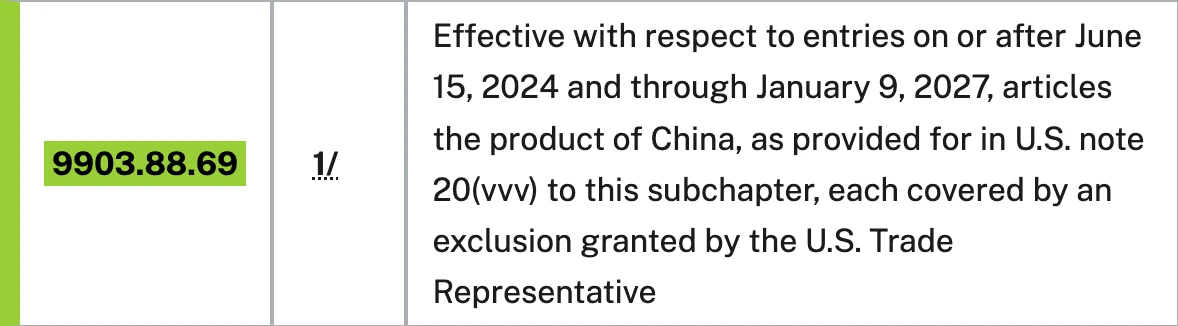
164 exclusions under heading 9903.88.69
These are the exclusions USTR kept in May 2024, out of 429 then in force. They are described in U.S. notes 20(vvv)(i) to (iv) to Chapter 99 of the HTSUS.
14 solar equipment exclusions under 9903.88.70
These cover machinery for making solar wafers and solar cells, granted in September 2024. They are described in U.S. note 20(www).
5 exclusions with new HTS numbers since July 1, 2026
The USITC changed some 10-digit statistical numbers on July 1, 2026. USTR updated five exclusions to match in September and October 2026.
Section 301: the trade law USTR used in 2018 and 2019 to put extra duties on Chinese goods over technology transfer and intellectual property practices.
What the Section 301 exclusion list covers, by HTS number
An exclusion removes the extra Section 301 duty from one specific product. It does not change the regular duty or any other tariffs.
Each exclusion is defined by a 10-digit HTSUS number and a product description in Chapter 99. Both must match your product.
Open to any importer: an exclusion applies to any product that meets its description, not just to the company that asked for it.
The 164 under 9903.88.69: these are the exclusions reinstated in 2022 or added for COVID response that USTR kept in 2024.
Solar manufacturing equipment: the 14 exclusions under 9903.88.70 cover equipment to make solar wafers and cells. USTR refused 5 more for module equipment in 2024.
Updated numbers: since July 1, 2026, three exclusions use 8413.91.9039, 8413.91.9046, 8413.91.9059 or 8413.91.9099. Others now use 3926.90.9915, 3926.90.9920 or 8479.90.9591.
The written product description decides coverage. A matching HTS number alone does not qualify a product.
Why USTR keeps extending Section 301 exclusions
The current 178 exclusions trace back to a 2024 review. USTR kept exclusions only where importers were shifting sourcing out of China or the product was hard to find elsewhere.
They were then extended three times in 2025. Under the November 1, 2025, US and China trade deal, the United States agreed to extend them until November 10, 2026.
This latest two-month extension follows the same pattern. USTR says it may extend further or make other changes.
What comes next for Section 301 tariffs
The exclusions expire again after January 9, 2027, unless USTR acts. Importers should watch for another notice before then.
USTR also opened its second four-year review of the China Section 301 tariffs on May 6, 2026. Domestic industries could ask to keep the duties in windows that closed July 5 and August 22, 2026.
If the duties continue, USTR will announce a second phase in later notices. That phase would invite public comments from all interested parties.
Key dates
May 30, 2024: 164 exclusions kept. USTR extended 164 of 429 exclusions and let the rest lapse.
September 18, 2024: 14 solar exclusions granted. They cover wafer and cell manufacturing equipment, back to January 1, 2024.
May 6, 2026: Second four-year review opened. It covers both 2018 Section 301 actions on China.
November 10, 2026: All 178 extended. The extension starts at 12:01 a.m. ET on this date.
January 9, 2027: Exclusions expire. Coverage ends at 11:59 p.m. ET unless USTR extends it again.
How to check if Section 301 exclusions apply to your imports
Find your 10-digit HTS number. Confirm the current statistical number, including any change made on July 1, 2026.
Read the Chapter 99 notes. Compare your product with the descriptions in U.S. notes 20(vvv) and 20(www). The description must match, not just the number.
Declare the right heading. Report 9903.88.69 or 9903.88.70 with the product's own HTS number, following CBP's entry instructions.
Check entries since July 1, 2026. If your exclusion was renumbered, confirm you used the updated statistical number.
Plan for January 10, 2027. Budget for the full Section 301 duty in case the exclusions are not extended again.
Frequently asked questions
What are Section 301 exclusions?
They are product-specific exemptions from the extra Section 301 duties on Chinese goods. Each one covers a product described in Chapter 99 of the HTSUS.
How long are the Section 301 exclusions extended?
Through 11:59 p.m. ET on January 9, 2027. The extension applies to goods entered on or after November 10, 2026.
Is there a Section 301 tariffs list of excluded products?
Yes. The 178 exclusions are listed in U.S. notes 20(vvv) and 20(www) to Chapter 99 of the HTSUS, under headings 9903.88.69 and 9903.88.70.
Can I apply for a new Section 301 exclusion?
This notice did not open a new request process. It only extends the existing 178 exclusions.
This article is informational and is not legal or customs advice.